There are roughly 700,000 wind turbine blades turning in the world, and about 3,800 of them fail every year. That is the figure a US Department of Energy report takes from a 2022 study of blade failures. It sounds small: half a per cent. But each of those failures costs between 300,000 and 500,000 dollars to replace, according to ONYX Insight, before you count lost production or the safety risk. Regular inspection is the tool the sector relies on to stop that number growing. And that is the real question: not whether anyone looks, but how they look, when, and with the machine in what state.
This is a map of the industry that has grown up around that question. Who inspects blades, with what, what each method solves and the limitation nearly all of them share.
The size of the problem
Global wind capacity passed 1,299 GW at the end of 2025 after a record year of 165 GW of new installations, according to GWEC's Global Wind Report 2026. In 2025 alone, 28,395 turbines went up worldwide. Each carries three blades that need checking regularly for twenty or thirty years.
In Spain the number is more manageable but hardly small: 32,910 MW in operation across 1,454 wind farms as of March 2026, according to the Spanish Wind Energy Association (AEE), covering 24% of electricity demand. And one peculiarity we will come back to at the end: it is one of the oldest fleets in Europe.
Looking is not cheap either. The DOE report, citing a drone operator, puts a rope-access inspection at around 3,525 dollars per turbine once you include the production lost during the ten hours the machine is stopped. The same inspection by drone comes to about 769 dollars, with roughly 45 minutes of downtime. These are vendor figures with their own assumptions, but the order of magnitude explains why the sector has moved so fast.
Ropes, platforms and a technician on a line
The classic method is still a certified technician abseiling down the blade. They see up close, they touch, they repair on the same visit. It is the benchmark everything else is measured against and, for repairs, it remains irreplaceable. Its limits are well known: the rotor has to be at a complete standstill with the blade at six o'clock, as the same report describes. It depends on wind, on rain, and on the availability of technicians who, as Aerones noted when announcing its 2023 funding round, are scarce and cannot work in bad weather. And every blade is a day's work.
Suspended platforms and blade lifts reduce the physical risk but not the premise: machine stopped, work at height, one turbine per shift.
Drones: the industrialisation of looking
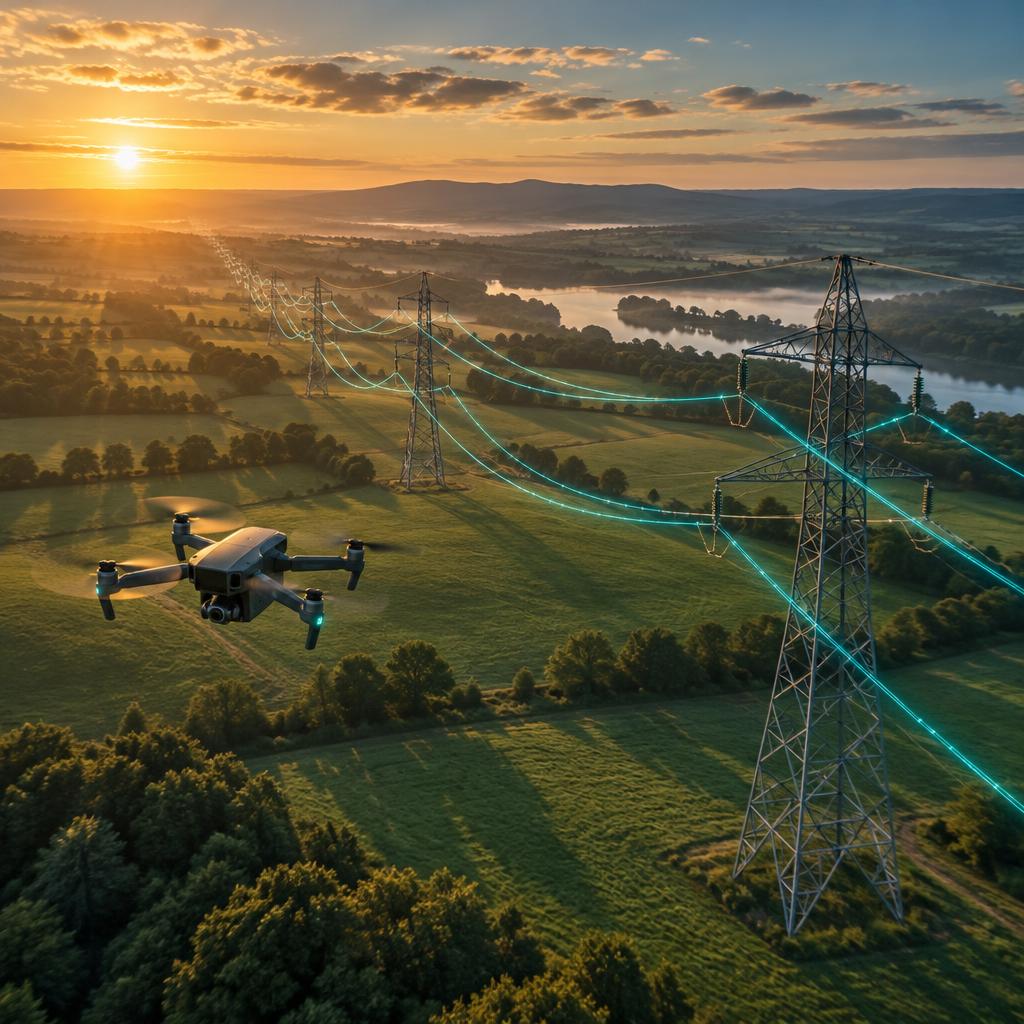
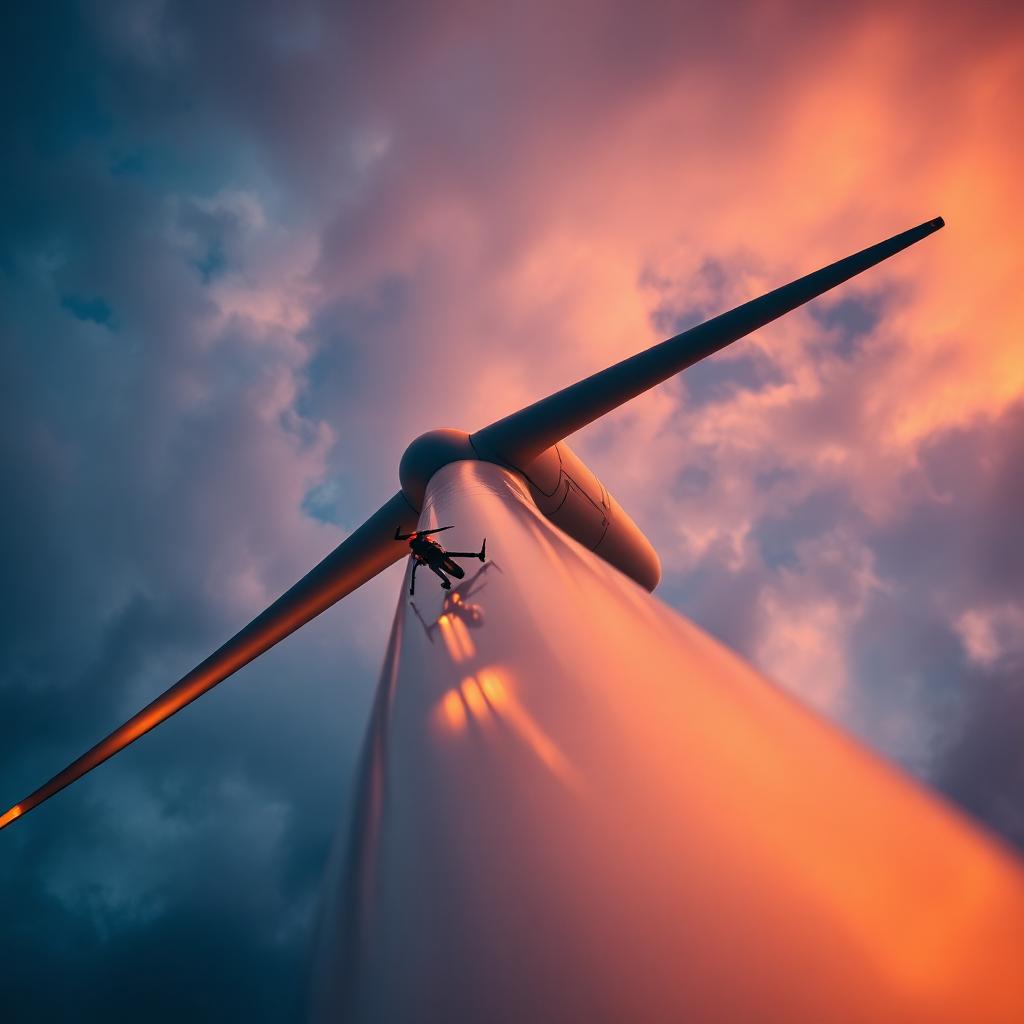
This is the bulk of today's market. SkySpecs announced in 2018 that it had passed 33,000 blades inspected by autonomous flight, with a record of 1,500 turbines in 30 days, operating in six countries and offshore. Sulzer Schmid wrapped up a 2021 campaign of close to 4,000 Vestas turbines across 14 countries in northern and central Europe, at up to 18 machines a day, and its 3DX platform lets operators annotate damage and track how it progresses between inspections. The DOE report puts a drone inspection at around fifteen minutes per machine.
What the drone solves is scale: an entire fleet photographed in weeks, in high resolution, with a comparable history. What it does not solve is the premise. To photograph a blade sharply the drone needs it to hold still. The rotor is stopped, oriented, flown, released. Minutes rather than hours, but still a stop, and still a visual inspection of the surface: it sees leading-edge erosion, open cracks, lightning strikes. It does not see whether the blade deflects more than it should when it is working.
Robots that walk the blade
The next wave tries to deliver the technician's arm without the technician. In October 2020 BladeBUG completed the first robotic blade walk on an offshore turbine, on ORE Catapult's 7 MW demonstration machine at Levenmouth, Scotland: 50 metres along an 84-metre blade, vacuum feet gripping the composite, scan data streamed live to shore. ORE Catapult estimated a 30% saving against rope access, rising to 50% on next-generation turbines. Aerones, from Latvia, raised 27.7 million euros in 2023 for robots that inspect, repair leading edges and test lightning protection, promising to be six times faster than current processes.
It is the right answer to a real problem: contact inspection and repair, at height, without people. But the robot clings to a stationary blade. The machine stays stopped while it works.
Sensors inside the blade
The fourth route does not inspect; it monitors. In 2024 ONYX Insight launched ecoPITCH, a sensor system for the blade root connection, field-tested for two years on more than 3,000 blades across a thousand turbines, promising up to twelve months of warning before a root failure. It is continuous monitoring with the turbine running, and it is the only approach on this map that does not require a stop. In exchange, it measures what the sensor touches. An accelerometer at the root knows the root. The geometry of the remaining sixty metres of blade lies outside its reach.
Let us compress the map into a line. Ropes: contact and repair, a day per machine, stopped. Drones: scale and good imagery, minutes, stopped. Robots: contact without people, stopped. Embedded sensors: no stop, but blind to the blade's shape. All of them measure the blade at rest, or measure one point of it. Nobody measures the whole blade doing what a blade does: turning under load.
Measuring in motion
That gap is the one we chose to go after at Azimutal with APEO, and the reasoning is almost obvious once said aloud: a blade at work is not the same object as a blade at rest. Deflection, twist, behaviour under real wind only exist while it turns. A static photograph describes the condition of the surface; it does not describe the structure.
APEO is a remote metrology system for structures in motion. From the ground, from a vehicle, an aerial platform or a vessel, it combines high-resolution imagery with LiDAR telemetry, tracks the rotor automatically and reconstructs each blade in 3D throughout its rotation. No stops, no work at height. The output is not a gallery of photographs but a geometry: the three blades of one rotor can be compared with each other, one turbine with its neighbour, or the same machine under two different operating conditions. It is the move from visual inspection to what we call dynamic structural metrology.
It has not been quick. The first prototype was validated with AENOR in 2022; in 2023 we carried out a structural dynamics study of blades, and through 2024 and 2025 we have led the monitoring systems on an offshore wind project. It does not replace the rope technician who repairs, the drone that photographs erosion or the root sensor. It adds the layer that was missing: the whole blade, measured while it produces.
Why it matters now: the fleet is ageing
Back to Spain. WindEurope puts the average age of the Spanish fleet at 14 years; more than half of the installed turbines are over fifteen, and according to AEE data reported by El Español, 8,440 MW are more than twenty years old and 1,433 MW more than twenty-five. Over 27% of installed capacity is approaching the end of its design life.
The logical answer would be repowering, and in 2025 the Spanish government approved a national roadmap and dedicated grants. But reality moves slowly: 24 MW were repowered in 2025, according to WindEurope's annual statistics, and the AEE describes the pace as far below what is needed. Where it does happen, the change is dramatic: at Aldeavieja, 22 turbines were replaced by four.
In the meantime, thousands of machines will keep turning beyond the twenty years they were designed for. Deciding whether a blade from 2004 can work for another five years is not an aesthetic question. It is a structural one, and the only honest way to answer it is to measure how that blade behaves, today, under real load, and to measure it again in a year's time. That is where a stop-and-look inspection falls short, and where measuring in motion stops being a technical curiosity and becomes a decision-making tool.
The fleet will age with or without us. The difference is whether we watch it turn or only ever see it standing still.
Sources
- China leads global wind power installations, as additions surge 40 per cent in 2025 (GWEC Global Wind Report 2026) — Eco-Business, 2026
- GWEC: record wind capacity installed in 2025 as five manufacturers surpass 100 GW cumulative (Supply Side Data Report) — BalticWind, 2026
- La eólica roza los 33 GW en España — Asociación Empresarial Eólica (AEE), 2026
- Presentación del Estudio Macroeconómico del sector eólico — Asociación Empresarial Eólica (AEE), 2025
- Los parques eólicos de España, entre los más viejos de Europa — El Español / Invertia, 2024
- Repotenciación eólica en España — Energías Renovables, 2026
- Commercial Potential Evaluation: Drone and Robotic Inspection of Wind Turbines — U.S. Department of Energy / Dawnbreaker, 2023
- SkySpecs reaches 33,000 autonomous wind turbine blade inspections — Robotics & Automation News, 2018
- Sulzer Schmid completes multi-GW blade inspection campaign for Vestas — Renewable Energy Magazine, 2021
- BladeBUG completes world's first blade walk on offshore turbine — ORE Catapult, 2020
- Riga-based Aerones secures €27.7 million for wind turbine maintenance robots — EU-Startups, 2023
- ONYX Insight launches blade root monitoring system (ecoPITCH) — Energy Global, 2024