In April 1970, oxygen tank number 2 on Apollo 13 ruptured 320,000 kilometres from Earth. What saved the crew was not software. Houston had physical simulators of the spacecraft, and the engineers reconfigured them to mirror the crippled ship and rehearse every manoeuvre before reading it up to the crew. That “twin” was made of aluminium and wiring. Half a century on, the word has gone digital and turns up in every transformation deck. The question a network operator should ask is not whether they need a digital twin, but what is actually underneath the slide.
What Grieves said, not what the brochure says
The concept has an author and a date. Michael Grieves presented it in his executive course on Product Lifecycle Management at the University of Michigan, in 2002 or 2003 depending on the source. His original definition fits in one sentence and is worth keeping to hand: a physical product in real space, a virtual replica in virtual space, and the data connections that keep the two tied together. The name “Digital Twin” came later; Grieves himself credits John Vickers of NASA, and a NASA roadmap picked it up in 2010. In other words, the twin was born as a lifecycle idea, not a visualisation idea. Without that third element, the live connection between physical and virtual, what you have is a very handsome 3D model.
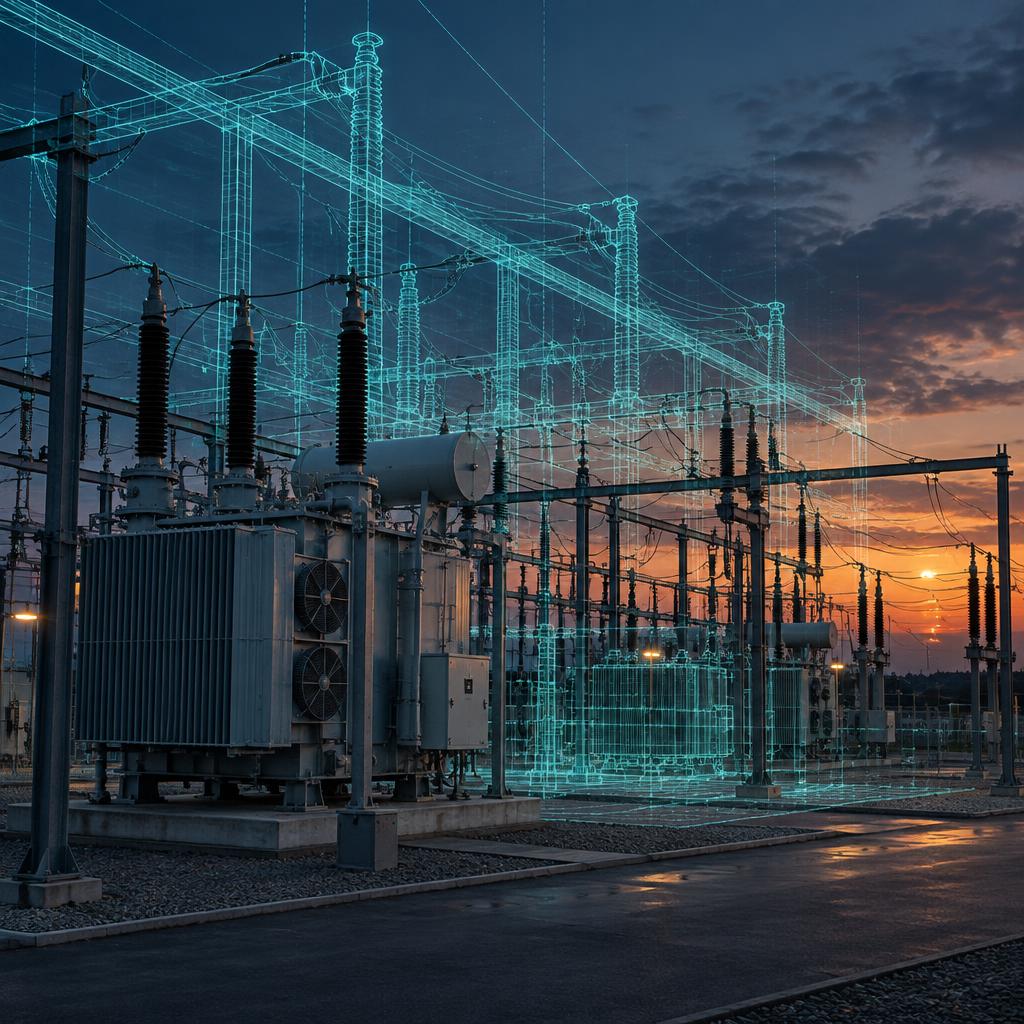
The distinction matters because it is precisely where marketing cheats. A BIM model of a substation is a model. A point cloud of a line is a point cloud. A twin is the model plus the inventory of every component plus a channel through which that inventory updates when someone swaps an insulator. The first can be bought in a month. The third takes years to build.
The hype cycle, with dates
Gartner has tracked the digital twin on its Hype Cycle for a decade. In August 2018 it placed blockchain and IoT platforms just past the peak of inflated expectations, “with digital twins on their heels”. Six months later, its survey of 599 organisations running IoT projects found that only 13% were already using digital twins, though another 62% said they were building them or planned to within a year. Analyst Benoit Lheureux was candid: true integration “is still relatively complicated and requires high-order integration and information management skills”. Translated: the hard part is not the screen, it is the data.
Market figures deserve the same scepticism. Grand View Research expects the global digital twin market to reach 328.51 billion dollars by 2033, growing at 31.1% a year from 2026. These are projections from consultancies with an interest in the market looking enormous, and they lump together everything from semiconductor fabs to smart cities. They are useful for one thing: confirming that the money is flowing, and that plenty of vendors therefore have an incentive to call almost anything a “twin”.
What the big players sell
The three names in any tender are Hexagon, Bentley and Siemens, and it helps to understand that they do not sell the same thing.
Hexagon unveiled HxDR at CES in 2020: a cloud platform where you upload capture data (point clouds, drone scans, 3D models) and it fuses them automatically into what they call a “Supermesh”. It is, above all, a reality-capture platform. Hexagon sells the container and the pipe to fill it; the sensors, in large part, are its own (Leica).
Bentley launched iTwin Experience, iTwin Capture and iTwin IoT in November 2022. The interesting piece for an operator is iTwin Capture: it turns drone video, survey imagery or scans into “engineering-ready” models, so the twin can start from captured reality rather than from a BIM model that almost never exists for forty-year-old assets. Keith Bentley put it plainly: “infrastructure digital twins are the future of our industry and our company”.
Siemens plays in a different league: operations. LV Insights X, presented in 2023 under the Xcelerator umbrella, builds the twin of the low-voltage network from what the distributor already holds (GIS, meter data management, ADMS) and promises to cut data-handling effort by up to 80% and network-model maintenance by 50%. Note the fine print: Siemens assumes the GIS is right. That is the catch, because in many networks it is not.
What operators are actually doing
The public cases in electricity networks tell a less glamorous and more useful story than the brochures.
National Grid presented Triton with Atos in January 2026: a digital twin of the British transmission network that consolidates thousands of datasets from distribution and transmission operators to model reinforcement scenarios and assess what happens if a data centre connects at a given point. National Grid says it cuts analysis and decision time on reinforcements by 70%. The telling detail is that Triton is, in essence, a machine for integrating other people's inventories. It won the “Unlocking Data” award at the Utility Week Awards 2025. Unlocking data, not unlocking simulation.
Endesa announced in August 2023 a 40-million-euro, three-year investment to build the digital twin of its distribution network: 50 specialised teams, 90,000 kilometres of medium- and high-voltage overhead lines, 1,311 substations and 144,000 distribution centres. And what does the work consist of? Flying the lines by helicopter, scanning transformers from the ground with heavier kit, taking 360º photographs and photographing the nameplate and barcode of every single item. In other words, the largest digital twin investment by a Spanish distributor is, in its first and most expensive phase, an industrial-scale geometric and documentary inventory campaign.
Enel, Endesa's parent, has modelled its network across nine countries as a graph with more than 600 million nodes and 800 million relationships, absorbing 500,000 queries a day. The most-quoted result is not a simulation: it is that automated connection quotes rose from 10% to 80%. Solution architect Leonisio Schepis's line sums up this article: “when you can trace every line, every station, every connection, you gain control”.
Eighty per cent is inventory
Here is the opinion. In a network digital twin, 80% of the value sits in a georeferenced, reliable, up-to-date inventory of every component, and 20% in the “twinness”: simulation, real-time sensors, prediction. The second is what appears in the videos. The first is what makes the second work.
The reason is simple. A simulation model fed a wrong input produces a wrong conclusion to three decimal places. If the GIS says a span carries a 1990 conductor and it was actually re-strung in 2012, the thermal-capacity simulation is fiction. If the twin does not know a breaker was replaced last year, its failure prediction is a nicely formatted random number. An operator needs, in this order: to know what they have, where it is, what condition it is in, and only then how it will behave. Projects that fail have usually bought the fourth step without paying for the first three.
There is an awkward corollary: without capture there is no twin. You cannot build the inventory of a 1985 substation from as-built drawings that were never updated. Someone has to go, measure, photograph and structure. Endesa has understood this, which is why its 40 million goes to helicopters and scanners before licences.
What we do with this
Azimutal has spent three decades measuring the territory, and in recent years more than 10,000 kilometres of power lines have passed through our sensors. From that experience comes GridScan, the technology we use to inventory an electricity network: from multi-sensor capture of substations and lines it automatically generates the digital twin of the network and the inventory of every component. The result is a structured 3D model with free navigation, to which documentation can be attached (that nameplate Endesa photographs) and sensors integrated when the operator decides to move into monitoring.
GridScan is our Ring 02: technology in development, born from real network projects and already in use with clients. We put it that plainly because the thesis of this article obliges us to: what we offer is the 80% part, the captured and structured inventory on which an operator can later mount Bentley, Siemens or whatever they prefer. We would rather build the foundations well than sell the façade.
A digital twin is not bought at a trade fair; it is raised substation by substation, nameplate by nameplate, and only then does it earn the name.
Sources
- Digital Twin: Manufacturing Excellence through Virtual Factory Replication — Michael Grieves, white paper, 2014
- The birth of digital twins — Nextspace, Apollo 13 and NASA 2010 roadmap
- Digital twin evolution: a 30-year journey — Simio
- Gartner Identifies Five Emerging Technology Trends (Hype Cycle 2018) — Gartner, 2018
- Gartner Survey Reveals Digital Twins Are Entering Mainstream Use — Gartner, 2019
- Digital Twin Market Size To Reach $328.51 Billion By 2033 — Grand View Research, 2026
- Hexagon debuts HxDR digital reality platform at CES — Geo Week News, 2020
- Bentley Systems Launches iTwin Experience, iTwin Capture, and iTwin IoT — Bentley Systems, 2022
- Software to create digital twins of low-voltage electricity grid (Siemens LV Insights X) — eeNews Europe, 2023
- National Grid unveils award-winning digital twin tool Triton — National Grid, 2026
- Endesa deploys 50 specialised teams and invests 40 million euros to create a digital twin of its distribution grid — Endesa, 2023
- Enel rebuilt its grid as a digital twin — Neo4j customer story